Google March 2026 Spam Update: Impact, Recovery & Prevention Guide
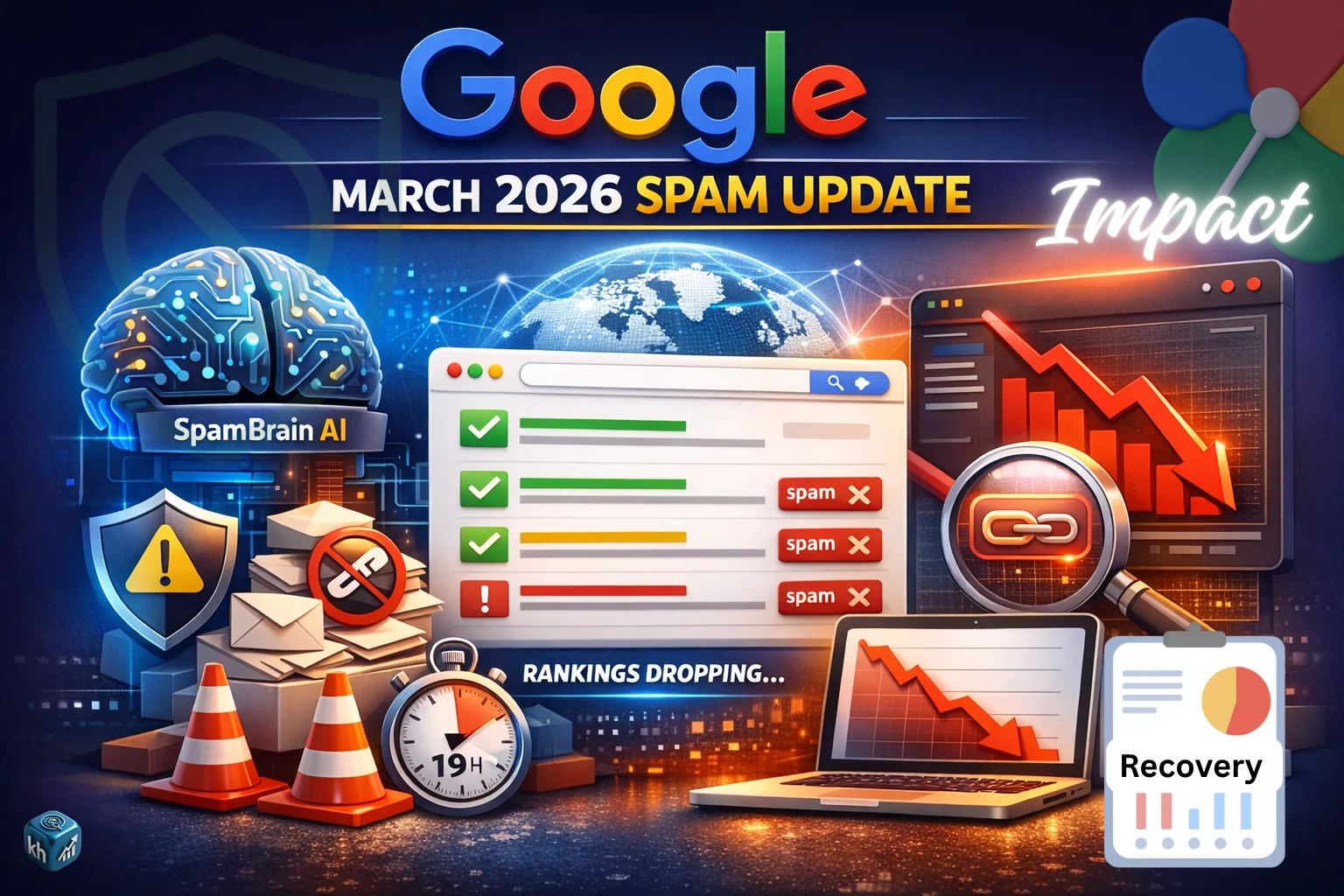
Google has officially released the March 2026 Spam Update, marking another refinement in its ongoing effort to improve the quality of search results. (Source)
According to the Google Search Status Dashboard, the update began rolling out on March 24, 2026, at 12:18 PM (US/Pacific) and was fully completed on March 25, 2026, at 07:30 AM (US/Pacific). The rollout was relatively fast, completing in roughly 19 hours, even though Google initially indicated it could take a few days. (Source)
The company classified the update as an “incident affecting ranking,” confirming that it directly impacts how websites appear in Google Search results. Google also stated that the update applies globally across all regions and languages, meaning no market or niche was excluded from its scope.
What Google Actually Launched
This update is not a new standalone algorithm but rather an improvement to Google’s existing spam detection systems. Google refers to such changes as “spam updates,” which are periodic enhancements made to better identify and filter spam content from search results.
In its official documentation, Google explains that its automated systems are always working to detect spam. However, when meaningful improvements are made to how these systems operate, those changes are formally announced as spam updates.
The March 2026 update falls into this category—an upgrade designed to make spam detection more effective, rather than introducing an entirely new ranking system. (Source)
Understanding What a “Spam Update” Means
Google’s definition of a spam update is straightforward but important. These updates represent improvements in how the search engine identifies content that violates its spam policies.
Rather than being a one-time change, spam detection is a continuous process. Google’s systems are constantly evolving, learning from new patterns and adapting to emerging spam techniques. When these improvements reach a level that significantly affects search results, Google publicly confirms them as updates.
This means that spam updates are not reactions to specific websites or industries. Instead, they are system-wide refinements that impact any site that does not comply with Google’s established guidelines. (Source)
The Role of SpamBrain in This Update
At the core of Google’s spam-fighting efforts is SpamBrain, an AI-based system specifically designed to detect and prevent spam.
Google describes SpamBrain as a system that continuously evolves to improve its ability to identify both known and new forms of spam. It analyzes patterns across the web, helping Google understand how spam behaves and how it changes over time.
The March 2026 Spam Update is understood to be part of these ongoing improvements to SpamBrain. Rather than targeting a single issue, the update strengthens the system’s overall ability to detect manipulative or low-quality practices more effectively.
This AI-driven approach allows Google to scale spam detection globally, ensuring that updates like this can be applied consistently across billions of web pages.
How Google’s Spam Detection System Operates
Google’s spam detection does not rely on manual reviews for updates like this. Instead, it is handled entirely through automated systems.
These systems continuously evaluate web content, looking for signals that indicate whether a page complies with or violates Google’s spam policies. The evaluation is not limited to content alone; it also considers patterns, behaviors, and other signals that may suggest manipulation.
Once the system identifies content that does not meet its standards, it can adjust rankings accordingly. This process happens automatically and at scale, without direct human intervention for each affected site.
Importantly, Google has clarified that such updates are not about penalizing websites manually. Instead, they are about improving the system’s ability to recognize and handle spam more accurately.
Ranking Impact and What Google Confirms
Google has made it clear that websites violating its spam policies may experience noticeable changes in search performance following a spam update.
These changes can include lower rankings or, in some cases, removal from search results altogether. However, this is not described as a penalty in the traditional sense. Instead, it is the result of improved detection systems identifying content that should not rank as highly.
For websites that follow Google’s guidelines, there is typically no negative impact. In fact, updates like these are intended to improve visibility for high-quality, compliant content by reducing the presence of spam in search results.
Global Scope and Rollout Behavior
One of the key characteristics of the March 2026 Spam Update is its global reach. Google confirmed that the update applies to all languages and regions, reinforcing that its spam detection systems operate at a worldwide scale.
The rollout itself was completed quickly. Although Google noted that such updates may take several days, this particular update finished in less than a full day. This suggests a highly efficient deployment of system improvements across Google’s infrastructure.
What Google Did Not Disclose
As with most spam updates, Google did not provide detailed information about specific signals, ranking factors, or exact changes made within the system.
There was no mention of:
- Particular industries being targeted
- Specific types of spam prioritized
- New ranking signals introduced
This aligns with Google’s standard approach of maintaining the integrity of its systems by not revealing precise detection methods.
Impact, Link Spam Behavior & How Google’s System Applies This Update
How the March 2026 Spam Update Affects Websites
With the rollout of the March 2026 Spam Update, Google has reinforced that ranking changes are not random but directly tied to how well a website complies with its spam policies.
This update does not introduce manual penalties or actions. Instead, it improves how Google’s systems identify and handle spam at scale, which means the impact varies depending on the quality and compliance of each website.
Websites that follow Google’s guidelines are unlikely to see negative effects. However, sites using manipulative techniques may experience a drop in visibility as the system becomes better at detecting those practices.
What changes can websites notice?
Based on Google’s official statements, the following outcomes are possible:
- Rankings may drop significantly for pages identified as spam
- Some pages may stop appearing in search results entirely
- Visibility loss can happen quickly after rollout completion
- Clean, policy-compliant websites may see relative improvement in rankings
This is not because Google is boosting good sites directly, but because removing or demoting spam allows better content to surface.
Understanding Google’s Spam Policies (Core of This Update)
Google has clearly stated that spam updates are tied directly to its Search Spam Policies. These policies define what is considered manipulative or harmful to search quality.
Instead of targeting specific tactics publicly, Google focuses on enforcing these policies through automated systems like SpamBrain.
Common areas covered under spam policies include:
- Misleading or low-value content
- Automatically generated or scraped content
- Manipulative link practices
- Cloaking or deceptive behavior
- Hidden text or keyword stuffing
The March 2026 update strengthens how effectively these violations are detected and handled.
Link Spam: One of the Most Important Signals
Google has specifically explained how its systems deal with link spam, making this a critical part of understanding the update.
Unlike older approaches where bad links could trigger penalties, Google now focuses on neutralizing the impact of spammy links rather than punishing the entire site.
Here’s how Google officially handles link spam:
- Spammy links are ignored
Google’s systems can detect unnatural or manipulative links and simply choose not to count them. - Ranking benefit is removed
If a website gained rankings through such links, that advantage is lost once those links are neutralized. - No recovery from those links
Even if the links are later removed or disavowed, the previous ranking boost does not return.
This is a key shift. Instead of penalizing aggressively, Google focuses on making spam tactics ineffective.
Real-World Impact Scenario (Based on Google Logic)
To understand this practically, consider two types of websites:
🔴 Website A (Using Manipulative Practices)
- Relies on artificial backlinks
- Uses low-quality or auto-generated content
- Focuses on ranking shortcuts
After the update:
- Spam signals are detected more accurately
- Links may be ignored
- Rankings drop because artificial advantage is removed
🟢 Website B (Policy-Compliant)
- Creates original, useful content
- Uses natural linking practices
- Follows Google guidelines
After the update:
- No negative impact
- May gain visibility as spam is filtered out
How the System Applies Changes (Behind the Scenes)
Google does not manually review each website during such updates. Instead, everything is processed through automated systems.
Here’s a simplified view of how the system applies changes:
- The updated system scans content and link signals
- It compares patterns against known spam behaviors
- It re-evaluates rankings based on improved detection
- Adjustments are applied across search results globally
This process happens continuously, not just once during the update window.
Recovery Timeline — What Google Officially Says
One of the most important points Google highlights is that recovery is not immediate.
If a website is affected by a spam update:
- Improvements need to be made first
- Google systems must reprocess and reassess the site
- This can take weeks to months, not days
Important clarification:
Fixing issues does not instantly restore rankings.
The system needs time to trust that the improvements are genuine and consistent.
Why This Update Matters for SEO
The March 2026 Spam Update reinforces a long-standing direction from Google:
ranking manipulation is becoming increasingly ineffective.
Instead of reacting to spam after it happens, Google is improving its ability to prevent spam from working in the first place.
Key takeaways for SEO professionals:
- Shortcuts like spammy links are no longer reliable
- Content quality and authenticity matter more than ever
- Compliance with Google policies is essential, not optional
Rollout Behavior and Observations
Even though Google stated the rollout could take a few days, this update completed in under 24 hours.
This indicates:
- Highly optimized deployment systems
- Immediate application of improved detection
- Faster reflection of changes in search results
Because the update is global, its impact is not limited to any specific industry or region. Any website violating spam policies could be affected regardless of location.
Recovery, Prevention, Full Summary & Complete Action Guide
What To Do If Your Website Is Hit by the March 2026 Spam Update
If a website experiences a drop after this update, Google’s official guidance is very clear: the issue is not the update itself, but non-compliance with spam policies that the system is now better at detecting.
There is no shortcut recovery method. The process requires identifying and fixing the root cause. (Source)
Step-by-Step Recovery Process (Based on Google Documentation)
1. Review Google’s Spam Policies Carefully
Start by auditing your website against Google’s official spam guidelines. The goal is to identify anything that could be considered manipulative or low-value.
2. Identify Problem Areas
Focus on key areas where violations commonly occur:
- Content quality (thin, auto-generated, or copied content)
- Link profile (unnatural backlinks or link schemes)
- Deceptive practices (cloaking, misleading pages)
3. Remove or Fix Violations
Once identified:
- Delete or improve low-quality content
- Remove manipulative elements
- Clean up unnatural linking practices where possible
4. Improve Overall Site Quality
Google emphasizes long-term quality signals. This includes:
- Creating original, helpful content
- Ensuring transparency and trustworthiness
- Avoiding shortcuts for rankings
5. Wait for System Reassessment
This is critical.
Google has clearly stated that:
- Recovery does not happen immediately
- Systems may take weeks or even months to reassess improvements
There is no “submit for reconsideration” option for algorithmic spam updates. Everything depends on automated systems recognizing sustained improvements.
Important Reality About Recovery
One of the most misunderstood aspects is link-related recovery.
If rankings were previously boosted by spammy links:
- Google may now ignore those links completely
- Any ranking benefit from them is permanently lost
- Even after fixing links, previous rankings may not return
This means recovery is not about “getting back” old rankings, but about building new, legitimate signals.
How to Keep Your Website Safe from Future Spam Updates
Google’s direction is consistent: prevention is easier than recovery.
Instead of reacting to updates, websites should align with Google’s systems from the beginning.
Core Practices to Stay Safe
Follow Google’s spam policies strictly
- Avoid manipulative tactics
- Focus on genuine value
Build content for users, not search engines
- Prioritize usefulness over keyword targeting
- Avoid automation without quality control
Maintain a natural link profile
- Earn links organically
- Avoid paid or artificial link schemes
Ensure transparency and trust
- Clear authorship
- Accurate information
- No deceptive behavior
What NOT to Do (Based on Google Guidance)
- Do not rely on shortcuts for rankings
- Do not expect quick fixes after a drop
- Do not assume removing issues instantly restores rankings
Google’s systems are designed to reward consistent, long-term quality, not temporary changes.
Long-Term SEO Direction After This Update
The March 2026 Spam Update reinforces a major shift:
👉 Google is not just detecting spam — it is making spam ineffective.
This means:
- Manipulative tactics lose value over time
- AI systems like SpamBrain continuously improve
- Sustainable SEO now depends entirely on compliance and quality
Summary
- Google launched the March 2026 Spam Update
- Rollout duration: ~19 hours (March 24–25, 2026)
- Impact: Global (all languages & regions)
- System involved: SpamBrain (AI-based spam detection)
Key effects:
- Spammy websites may lose rankings
- Manipulative links may be ignored
- No manual penalties — fully automated
Recovery reality:
- Requires fixing policy violations
- Takes weeks to months
- Lost link value does not return
Prevention focus:
- Follow Google spam policies
- Create high-quality, original content
- Avoid manipulation in any form
FAQ
It is an improvement to Google’s automated spam detection systems, designed to better identify and filter spam content.
Yes, Google confirmed it applies globally across all regions and languages.
No. Google describes it as a system improvement, not a manual penalty.
Google states recovery can take weeks to months, depending on when systems reassess the site.
No. If links were ignored, the previous ranking benefit is permanently lost.
Author
Harshit Kumar is an AI SEO Specialist with 7+ years of experience and the founder of kumarharshit.in. He is known for practical SEO experiments, indexing systems, and breaking down Google updates into actionable insights.


Leave a Reply