Google Analytics Data Control Update (June 2026): What Changed, Impact & What You Must Do
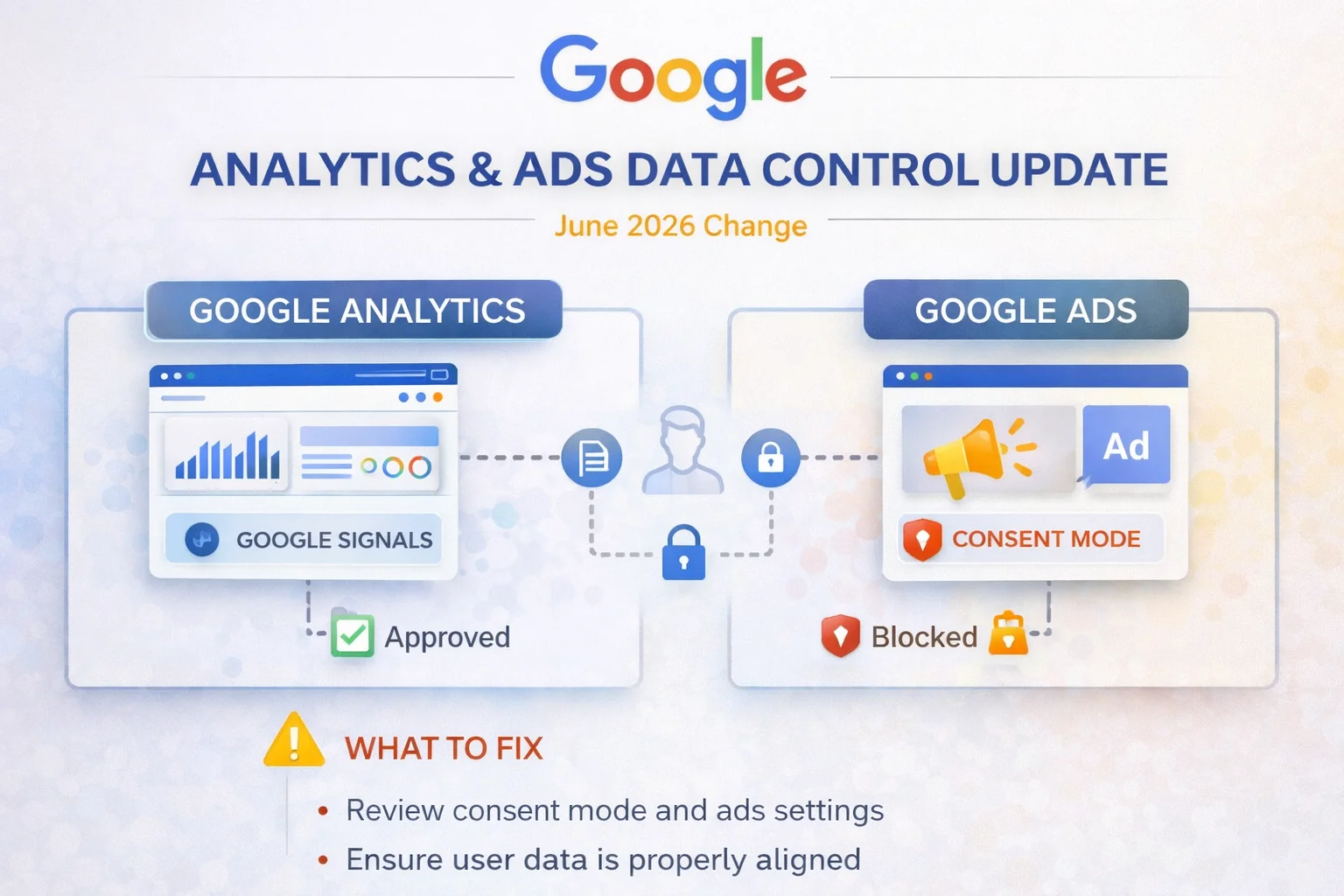
Google has announced a significant update to how data is controlled between Google Analytics and Google Ads. The change was communicated via an official email on April 13, 2026, and will begin rolling out from June 15, 2026.
This update focuses on simplifying how data is managed across both platforms while aligning usage strictly with user consent. It primarily affects businesses that have linked their Google Analytics and Google Ads accounts and rely on shared data for tracking, targeting, and performance optimization.
What Exactly Has Changed
Until now, data collection and usage across Google Analytics and Google Ads were influenced by a combination of settings, including Google Signals and Consent Mode. This often created overlap and confusion in how data was actually being controlled.
With this update, Google is introducing a clear separation.
From June 2026 onward, data usage will be handled independently depending on where it is being used. When data is used within Google Analytics, it will be governed by Analytics-specific controls such as Google Signals and related APIs. However, when that same data is used within Google Ads, it will be controlled exclusively by Ads Consent Mode.
This shift removes shared control and replaces it with a more structured, platform-specific approach.
Why Google Is Making This Change
Google has positioned this update as part of its broader effort to improve privacy and simplify system behavior.
Previously, having multiple overlapping controls created inconsistencies. In some cases, the same user data could be interpreted differently depending on which platform was accessing it. By separating control mechanisms, Google ensures that user consent is applied more clearly and consistently.
The goal is straightforward: reduce confusion for developers and marketers while strengthening user privacy alignment.
How the New System Works
After the update goes live, the system becomes easier to understand, even though it may require initial adjustments.
When data is processed inside Google Analytics, it will follow the rules defined by Analytics settings. This includes Google Signals, which controls how user data is associated across devices and sessions.
On the other hand, when data flows into Google Ads—whether collected directly or shared from Analytics—it will no longer depend on Analytics settings. Instead, Ads Consent Mode will have full control over whether that data can be used for advertising purposes.
In practical terms, this means that even if Analytics is collecting data, Ads may not be able to use it unless proper consent is granted through Consent Mode.
What You Need to Check Immediately
This update does not require action from everyone, but it does require awareness.
If your Google Signals setting is already enabled, Google has stated that no immediate changes are necessary. Your current setup will continue to function as expected.
However, if Google Signals is turned off, the behavior of your data may change after June 15. In such cases, Google Ads may begin using Ads cookies when users provide consent, and this could affect how audiences and conversions are tracked.
There is also a third scenario to consider. If you are intentionally restricting data usage—for example, by setting Consent Mode to deny ad storage—then you must be aware of the trade-offs. Blocking ad storage prevents advertising cookies and identifiers from being used, which directly impacts conversion tracking and campaign performance.
A Practical Example to Understand the Shift
Imagine a website that relies on Google Analytics for tracking and sends that data to Google Ads for remarketing campaigns.
Before this update, Analytics settings could influence how that data behaved in Ads. After the update, that connection becomes conditional.
If a user does not grant consent for ad storage, Google Ads will not be able to use that data—even if it exists in Analytics. This creates a more privacy-first environment but also introduces potential gaps in tracking.
The Real Impact on Marketing and SEO
While this update does not directly affect search rankings, its indirect impact is significant.
Accurate data is the foundation of decision-making in SEO and paid marketing. If tracking becomes inconsistent due to improper setup, businesses may struggle to measure performance correctly.
From an advertising perspective, the impact is even more direct. Conversion tracking, audience building, and campaign optimization all depend on how data is collected and shared. Any disruption in this flow can reduce efficiency and increase costs.
For SEO professionals, the effect shows up in reporting and insights. If analytics data becomes incomplete, it may lead to incorrect conclusions about user behavior and content performance.
The Biggest Risk You Should Not Ignore
The most critical risk is not the update itself—it is ignoring the update.
If systems are not reviewed and aligned with the new structure, businesses may experience silent data loss. This means tracking may appear to work, but important signals could be missing.
Over time, this leads to:
- Misleading reports
- Poor campaign decisions
- Reduced return on investment
What Google Recommends
Google’s guidance is clear but requires careful implementation.
You should review your current setup, especially if you are using linked Analytics and Ads accounts. Pay attention to how consent is being handled and whether your configuration reflects user choices accurately.
If needed, update your Consent Mode implementation and ensure that your privacy disclosures are aligned with how data is being collected and used.
Google has also provided a grace period of up to 90 days for businesses that need additional time to adjust their systems.
Timeline and Rollout Details
The update was announced on April 13, 2026, and will start rolling out from June 15, 2026. This gives businesses a limited but sufficient window to prepare.
The changes will apply globally and affect all users who rely on data sharing between Google Analytics and Google Ads.
Final Insight:
This is more than a technical adjustment—it reflects a broader shift in how digital marketing works.
Google is moving toward a model where data usage is strictly governed by user consent, rather than system capabilities. This means marketers must adapt to a reality where not all data is available all the time.
Success will depend not just on strategy, but on how well systems are configured to respect and work within these new constraints.
FAQ
It changes how data is controlled between Google Analytics and Google Ads, separating their control systems and aligning them with user consent.
The changes will start applying from June 15, 2026.
If Google Signals is enabled, no action is needed. Otherwise, you should review your Consent Mode and tracking setup.
No direct impact on rankings, but it may affect data accuracy used for SEO decisions.
Conversion tracking and campaign performance may be significantly affected.
Author
Harshit Kumar is an AI SEO Specialist with 7+ years of experience and the founder of kumarharshit.in. He specializes in technical SEO, data tracking systems, and decoding Google updates into actionable strategies.