Google Launches Official AI SEO Guide for AI Overviews & AI Mode: What Really Matters for Generative AI Search
Google Finally Explains How AI Search Visibility Actually Works
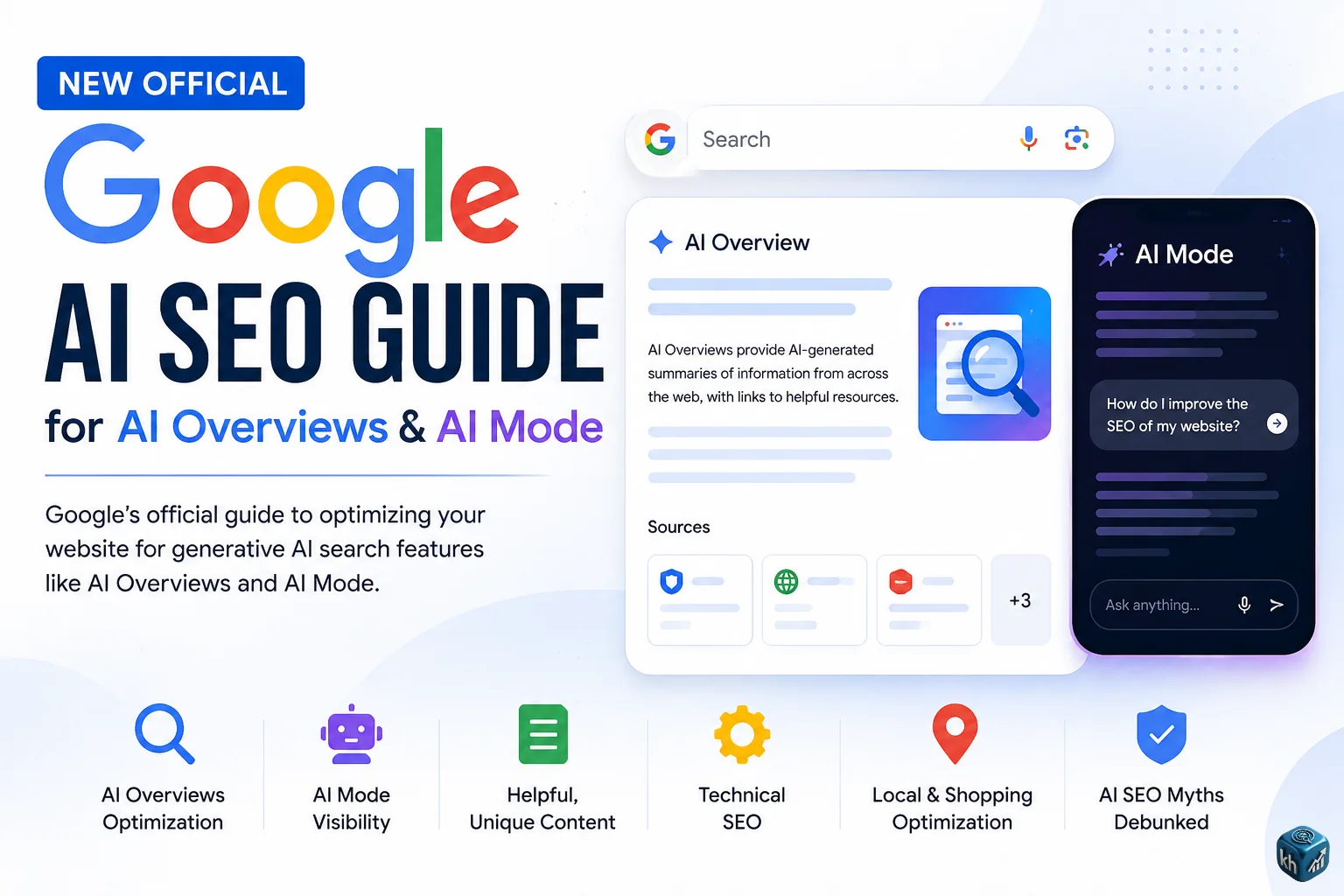
Google has officially released one of its most important SEO documents of the AI era — a new resource explaining how websites can optimize for generative AI experiences in Google Search, including AI Overviews and AI Mode.
The announcement was published through the Google Search Central Blog on May 15, 2026, alongside a detailed documentation page focused entirely on generative AI optimization.
This is not just another SEO recommendation page. It is Google’s clearest public explanation yet of:
- How AI-powered search systems work
- Whether SEO still matters in AI search
- What content performs well in AI-generated experiences
- Which AI SEO tactics Google considers unnecessary
- How technical SEO connects with AI visibility
- Why “AEO” and “GEO” are not separate from SEO
Most importantly, Google directly addresses many misconceptions currently spreading across the SEO industry. (Source)
Instead of introducing a completely new optimization system, Google confirms something that will surprise many people:
Traditional SEO remains the foundation of visibility in generative AI search.
What Google Actually Announced
Google published a new official guide titled:
“Optimizing your website for generative AI features on Google Search.”
The guide is specifically designed for:
- Website owners
- SEO professionals
- Developers
- Publishers
- Ecommerce businesses
- Local businesses
Its purpose is to help websites understand how they can appear in generative AI search experiences such as:
- AI Overviews
- AI Mode
- AI-generated search responses
At the same time, Google also released a companion blog post introducing the resource and summarizing its major themes.
According to Google, user behavior is rapidly shifting toward AI-powered search experiences, and websites need to understand how these systems retrieve, evaluate, and surface information.
However, Google repeatedly emphasizes throughout the documentation that this shift does not replace SEO fundamentals. (Source)
Google’s Biggest Statement: SEO Is Still Relevant
One of the most important sections of the guide directly answers a question dominating the SEO industry:
“Is SEO still relevant for generative AI search?”
Google’s answer is immediate and extremely clear:
“In short, yes!”
This statement matters because many marketers have recently pushed the idea that traditional SEO is becoming obsolete due to AI-generated answers.
Google disagrees.
The company explains that its AI-powered search experiences are deeply connected to:
- Core Search ranking systems
- Existing Search quality systems
- Google’s Search index
In other words:
AI search visibility still depends on the same foundational systems that power traditional Google Search.
How Google’s AI Search Systems Actually Work
The guide contains one of the most detailed public explanations Google has given about how generative AI search operates behind the scenes.
Two concepts are especially important:
- Retrieval-Augmented Generation (RAG)
- Query Fan-Out
These systems reveal how Google combines AI with traditional search infrastructure.
Understanding Retrieval-Augmented Generation (RAG)
Google explains that AI-generated responses are grounded using a process called Retrieval-Augmented Generation, often shortened to RAG.
This process works in several stages.
First, Google retrieves relevant web pages from its existing Search index using its core ranking systems. Then, the AI systems analyze the information found within those pages before generating a final response.
This means AI answers are not created in isolation. They depend heavily on:
- Indexed pages
- Search rankings
- Relevant web content
- Reliable information sources
Google says this process improves:
- Accuracy
- Freshness
- Reliability
Importantly, Google also confirms that these AI-generated responses include prominent clickable links pointing back to source websites.
That means website visibility still matters enormously.
Query Fan-Out: Why Context Matters More Than Exact Keywords
Another major concept Google explains is query fan-out.
This process allows AI systems to generate multiple related searches behind the scenes in order to better understand user intent.
Google even provides a practical example.
If a user searches:
“How to fix a lawn that’s full of weeds”
The AI systems may simultaneously explore related queries such as:
- Best herbicides for lawns
- Weed prevention techniques
- Removing weeds naturally
This reveals something extremely important about modern SEO:
AI systems are becoming better at understanding topics contextually rather than relying only on exact keyword matching.
Why This Changes SEO Strategy
This shift means websites no longer benefit from producing dozens of slightly rewritten pages targeting keyword variations.
Instead, Google’s systems increasingly reward:
- Comprehensive expertise
- Contextual relevance
- Topical depth
- Genuine insight
This also explains why Google repeatedly discourages manipulative AI SEO tactics throughout the guide.
Google’s New Focus: “Non-Commodity Content”
One of the strongest themes throughout the documentation is Google’s emphasis on what it calls:
“Non-commodity content.”
This phrase appears repeatedly because Google believes it is one of the biggest differentiators in AI search visibility.
What Google Means by Commodity Content
Commodity content refers to pages that:
- Repeat common information
- Add little original value
- Repackage existing knowledge
- Lack first-hand expertise
Google gives a direct example:
Commodity Example
“7 Tips for First-Time Homebuyers”
According to Google, this type of content is widely available and easily reproducible.
What Google Wants Instead
Google contrasts that with:
Non-Commodity Example
“Why We Waived the Inspection & Saved Money: A Look Inside the Sewer Line”
This type of content contains:
- Personal experience
- Unique perspective
- Real-world expertise
- Specific insight
Google strongly suggests that this type of content performs better in AI-powered search because it offers information that cannot easily be generated generically.
Google’s Position on AI-Generated Content
The company also addresses AI-assisted content creation directly.
Importantly, Google does NOT ban AI-generated content.
However, it says any AI-assisted content must still comply with:
- Search Essentials
- Spam policies
- Helpful content principles
Google specifically warns against creating large volumes of content solely to manipulate rankings or AI visibility.
This aligns with Google’s scaled content abuse policies.
Content Structure Still Matters
Despite all the AI discussion, Google repeatedly reinforces traditional content organization principles.
The guide recommends:
- Clear headings
- Logical sections
- Readable paragraphs
- Organized structure
Google explains that this helps both:
- Human readers
- AI systems understand content more effectively
This is important because many people assumed AI systems only needed fragmented or “chunked” content.
Google directly rejects that idea later in the document.
Technical SEO Remains Foundational
One of the strongest messages in the guide is that technical SEO is still critically important.
Google specifically highlights:
- Crawlability
- Indexability
- JavaScript SEO
- Page experience
- Duplicate content reduction
The company explains that AI systems still depend on Google’s existing crawling and indexing infrastructure.
This means:
If Google cannot properly crawl or index your content, it will struggle to surface it in AI-generated experiences as well.
Google’s Technical Requirements for AI Visibility
Google confirms that pages must:
- Be indexed
- Be eligible for snippets
- Meet Search technical requirements
before they can appear in generative AI features.
This statement destroys the myth that AI systems somehow bypass normal Search infrastructure.
They do not.
JavaScript SEO & AI Search
Google also specifically addresses JavaScript-heavy websites.
The company confirms it can process JavaScript content as long as it is not blocked. However, Google warns that JavaScript SEO remains more complex than traditional websites.
This means websites using:
- React
- Angular
- Vue
- Dynamic rendering systems
still need proper SEO implementation.
Images & Video Are Becoming More Important
Google explains that AI-powered search experiences can surface:
- Images
- Videos
- Product visuals
alongside standard web links.
This creates additional opportunities for visibility beyond traditional rankings.
Google recommends continuing:
- Image SEO best practices
- Video SEO optimization
rather than inventing new AI-specific media strategies.
Local SEO & Ecommerce in AI Search
The guide also highlights how generative AI search may include:
- Product listings
- Local business details
- Merchant information
Google specifically recommends:
- Google Business Profiles
- Merchant Center feeds
for businesses that want visibility in AI-powered shopping and local search experiences.
The Most Important Section: AI SEO Myths Google Wants You to Ignore
One of the most valuable parts of the guide is the myth-busting section.
Google directly addresses many AI SEO trends currently spreading online.
This section is extremely important because it separates:
- Official guidance
from - Industry speculation
Myth 1: LLMS.txt Files Are Required
Google clearly states:
You do NOT need:
- LLMS.txt files
- Special AI markup
- AI-specific machine-readable files
to appear in generative AI search.
This directly contradicts a growing number of third-party claims.
Myth 2: You Must “Chunk” Content for AI
Google also rejects the idea that content must be broken into tiny fragments for AI systems.
The company says its systems already understand:
- Multiple topics
- Context
- Long-form structure
There is no ideal page length.
Myth 3: Rewrite Content Specifically for AI Systems
Google says this is unnecessary.
Its systems already understand:
- Synonyms
- Intent
- Related meanings
This means websites do not need:
- Excessive long-tail keyword variations
- Artificial phrasing
- AI-specific writing styles
Myth 4: Fake Mentions Improve AI Visibility
Google warns against trying to generate:
- Artificial mentions
- Inauthentic discussions
- Manipulated visibility signals
The company says its ranking systems continue focusing on:
- Quality
- Trust
- Spam prevention
Google’s Official Position on “AEO” & “GEO”
Google acknowledges the growing use of terms like:
- AEO (Answer Engine Optimization)
- GEO (Generative Engine Optimization)
However, the company makes its position very clear:
Optimizing for generative AI search is still SEO.
This is arguably the most important industry takeaway from the entire guide.
Google is effectively saying:
There is no separate “AI SEO algorithm.”
Instead:
- AI visibility still depends on strong SEO foundations.
AI Agents: Google’s Future Direction
Toward the end of the document, Google discusses AI agents — autonomous systems capable of performing tasks on behalf of users.
Examples include:
- Browser agents
- Reservation assistants
- Product comparison systems
Google explains these systems may interact with websites through:
- DOM analysis
- Accessibility trees
- Visual rendering interpretation
This suggests Google is preparing for a future where AI systems interact with websites in much deeper ways than traditional crawling.
Why This Documentation Matters So Much
This is not just another Search Central update.
It is one of the clearest signals yet about how Google sees the future of search.
The company is effectively confirming:
- AI search is evolving rapidly
- SEO fundamentals still matter
- Helpful content remains central
- Technical SEO is still foundational
- Manipulative AI SEO shortcuts are not sustainable
Perhaps most importantly, Google is trying to prevent website owners from chasing myths and misinformation.
Final Summary
Google has released an official guide explaining how websites can optimize for AI-powered search experiences like AI Overviews and AI Mode. The company confirms that traditional SEO remains foundational to generative AI visibility, with systems still relying heavily on Google’s Search index, crawling infrastructure, and ranking systems. Google emphasizes the importance of unique, non-commodity, people-first content while rejecting many popular AI SEO myths such as LLMS.txt files, content chunking, and AI-specific rewriting strategies. Instead, the company recommends focusing on strong technical SEO, helpful content, clear structure, and authentic expertise as the long-term strategy for success in AI-powered search.
FAQ
The guide explains how websites can improve visibility in generative AI search experiences such as AI Overviews and AI Mode while continuing to follow standard SEO best practices.
Yes. Google directly states that traditional SEO remains foundational because AI search systems still depend on Search indexing, ranking, and quality systems.
Google recommends unique, non-commodity, people-first content with original expertise and first-hand experience.
No. Google explicitly says no special AI files or markup are required for generative AI search visibility.
Google says optimizing for generative AI search is still SEO and does not require a completely separate optimization framework.
Author
Harshit Kumar is an AI SEO Specialist with 7+ years of experience and the founder of kumarharshit.in. He specializes in technical SEO, AI-driven search systems, indexing behavior, and breaking down Google updates into actionable insights for publishers and businesses.