Google June 2026 Spam Update Released: Complete Breakdown, Impact, Recovery & How Website Owners Should Respond
Google Releases June 2026 Spam Update Affecting Search Rankings
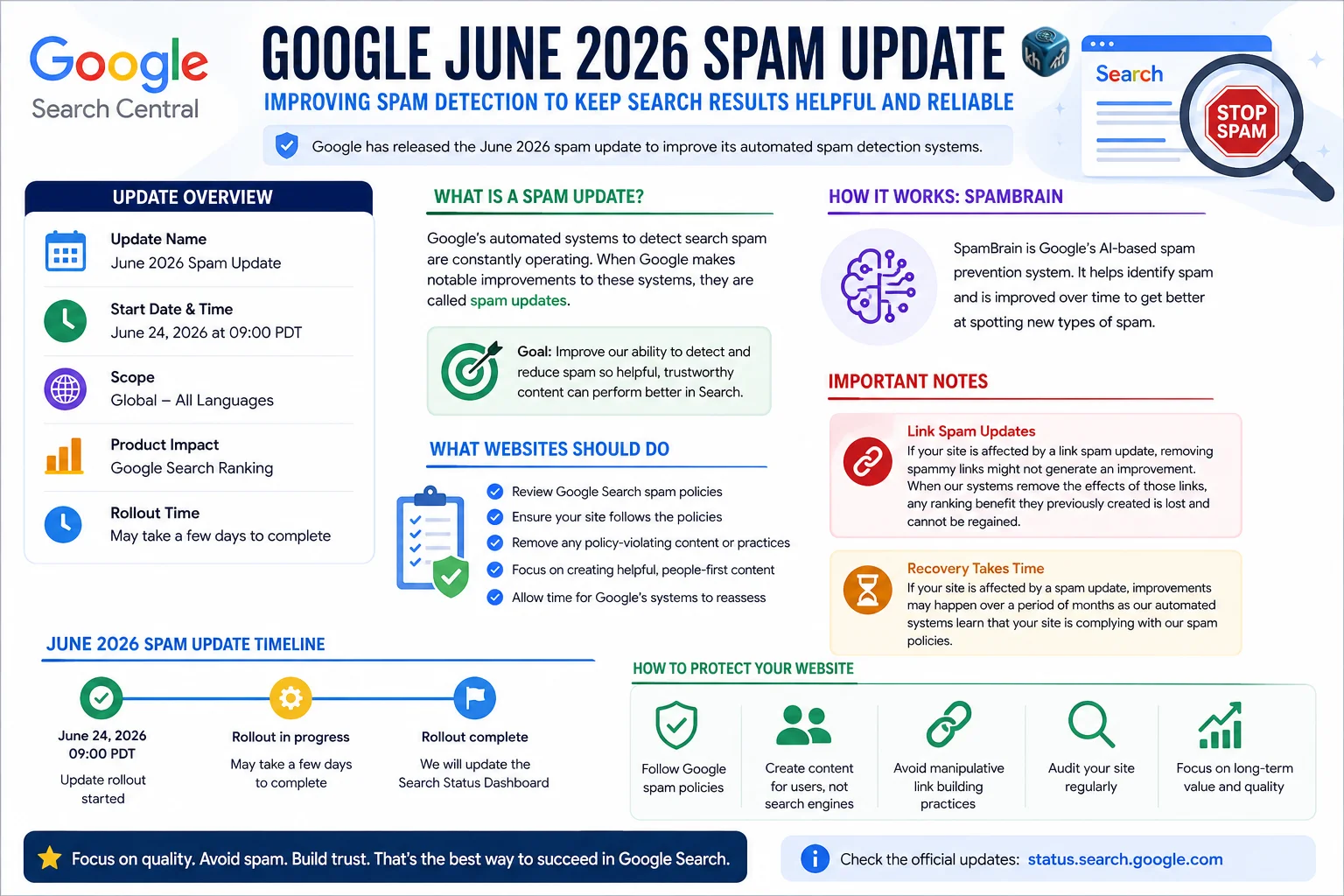
Google has officially started rolling out the June 2026 spam update, a new improvement to its automated spam detection systems designed to maintain the quality of Google Search results.
According to the Google Search Status Dashboard, the update began on June 24, 2026, at 09:00 PDT. Google confirmed that the update affects Search Ranking and applies globally across all languages. (Source)
The company stated:
“Released the June 2026 spam update, which applies globally and to all languages. The rollout may take a few days to complete.”
Like previous spam updates, this release represents another improvement in Google’s ongoing efforts to detect and reduce content or practices that violate Google Search spam policies.
Google’s automated systems are constantly working to identify spam, but when the company makes notable improvements to these systems, Google officially announces them as a spam update.
The June 2026 spam update continues that process by improving how Google identifies websites attempting to manipulate Search visibility.
What Is The June 2026 Spam Update?
The June 2026 spam update is an improvement to Google’s automated spam detection systems.
Google explains that its systems are continuously operating to detect search spam. From time to time, Google improves these systems to make them better at identifying existing and new types of spam.
When those improvements are significant, Google announces them publicly as spam updates.
Unlike some Search changes that focus on improving general ranking systems, spam updates specifically focus on detecting and handling websites that violate Google’s spam policies.
The goal is simple:
Improve the quality of Search results by reducing the visibility of spammy or manipulative content.
How Google’s Spam Detection Systems Work
Google uses automated systems to identify and prevent spam from appearing prominently in Search results.
One of the most important systems Google has publicly discussed is:
SpamBrain
SpamBrain is Google’s AI-based spam prevention system.
Google explains that SpamBrain helps identify spam and is improved over time so it can become better at detecting new forms of spam.
As spam techniques change, Google updates its systems to understand and respond to new patterns.
This means spam updates are not always about one specific spam type. They can involve broader improvements to Google’s ability to recognize violations.
June 2026 Spam Update Timeline
Here are the official rollout details confirmed by Google:
| Detail | Information |
|---|---|
| Update Name | June 2026 Spam Update |
| Start Date | June 24, 2026 |
| Start Time | 09:00 PDT |
| Product Impact | Google Search Ranking |
| Languages | Global — all languages |
| Rollout Time | May take a few days |
Google will update the Search Status Dashboard when the rollout process is completed.
During the rollout period, website rankings may experience changes as Google’s systems process the update.
Does The June 2026 Spam Update Affect All Websites?
The update applies globally, but that does not mean every website will experience ranking changes.
Spam updates mainly impact websites where Google’s automated systems detect practices that violate its spam policies.
A website following Google’s Search Essentials and spam policies may not notice any negative effect.
However, websites using manipulative techniques designed to artificially improve Search visibility may lose ranking signals or visibility.
Why Google Releases Spam Updates
Search spam is constantly changing.
People attempting to manipulate search engines often create new techniques to gain unfair visibility.
Google’s spam updates exist because detection systems must continue evolving.
The purpose is not only removing existing spam but also improving Google’s ability to identify new spam behaviors.
Google’s larger objective remains:
Deliver more helpful, trustworthy, and relevant results for Search users.
What Types Of Issues Can Spam Systems Target?
Google’s official spam policies cover many practices that attempt to manipulate Search.
Examples include areas such as:
- Content created primarily to manipulate ranking systems
- Deceptive practices
- Manipulative linking behavior
- Other violations listed under Google Search spam policies
The June 2026 announcement itself does not mention one specific spam category. Therefore, website owners should review all Google spam policies instead of assuming the update targets only one area.
Difference Between Spam Update And Core Update
Many website owners confuse spam updates with core updates, but they are different.
A core update improves Google’s overall ranking systems to better evaluate content quality and relevance.
A spam update focuses specifically on improving Google’s ability to detect spam policy violations.
Simple comparison:
| Core Update | Spam Update |
|---|---|
| Improves ranking evaluation systems | Improves spam detection systems |
| Focuses on overall content assessment | Focuses on policy violations |
| Not a penalty system | Can reduce spam visibility |
Understanding this difference helps website owners respond correctly.
What Happens If A Website Is Hit By The June 2026 Spam Update?
When a website loses visibility after a spam update, it usually means Google’s automated systems have identified signals that may not align with Google Search spam policies.
Google explains that websites affected by spam updates should review their content and practices to ensure they comply with official spam policies.
A decline after a spam update does not always mean a website has received a manual action. Google uses automated spam detection systems that continuously evaluate websites.
The most important step is understanding what changed and reviewing the website carefully instead of making random adjustments.
How To Check If Your Website Was Affected
Before assuming that a ranking drop is caused by the June 2026 spam update, website owners should analyze their data carefully.
Google Search Console is the first place to review performance changes.
Website owners can check:
- Search performance trends before and after June 24, 2026
- Pages with major impression or click changes
- Whether ranking changes happened during the rollout period
A temporary fluctuation during a rollout does not always indicate a long-term issue.
Because Google systems update gradually, website owners should analyze patterns instead of reacting immediately to small movements.
What To Do If Your Website Was Hit By The June 2026 Spam Update
Google’s official recommendation for websites affected by a spam update is clear:
Review Google Search spam policies and ensure the website follows them.
The goal is not to find a quick ranking trick. The goal is to remove practices that caused Google’s systems to lose trust.
Website owners should carefully audit areas where spam issues commonly occur.
Review Content Quality And Purpose
A good starting point is reviewing whether the website exists primarily to help users or only to gain search traffic.
Content should provide real value instead of being created only to manipulate Search performance.
Review:
- Does the content genuinely help users?
- Does it provide useful information?
- Is it created primarily for people?
Low-value pages that exist only for search manipulation can create problems.
Check For Spam Policy Violations
Website owners should compare their website against Google’s official spam policies.
The review should include:
- Content practices
- Technical behavior
- Link practices
- Any methods designed to manipulate rankings
The objective is not only fixing individual pages but improving the overall quality and compliance of the website.
Avoid Making Random Changes After A Spam Update
One mistake website owners often make after ranking drops is changing everything immediately.
A spam update requires careful analysis.
Deleting pages, changing the entire website structure, or rewriting everything without identifying the real problem may create additional issues.
A better approach:
- Confirm the timing of traffic changes
- Compare changes with the update rollout
- Review spam policy compliance
- Fix confirmed problems
- Allow Google systems time to reassess
How Long Does Recovery Take After A Spam Update?
Recovery from a spam update is usually not immediate.
Google explains that making improvements may help a website improve if its automated systems learn over a period of months that the website is complying with spam policies.
This is an important point.
Simply removing a problem today does not guarantee rankings return tomorrow.
Google’s systems need time to:
- Recrawl the website
- Process improvements
- Reassess signals
The recovery process depends on how quickly Google systems recognize sustained compliance.
Special Case: Link Spam Updates
Google gives additional guidance specifically for link spam updates.
A link spam update is designed to deal with spammy linking practices.
In these situations, making changes might not generate the same type of recovery.
The reason is that when Google removes the effects of spammy links, any ranking benefit those links previously created is lost.
That lost benefit cannot be regained simply by removing the spam.
For example:
If a website ranked because artificial links were giving it an advantage, and Google neutralizes those links, the previous artificial boost disappears.
The website then needs to earn visibility based on legitimate signals.
How To Protect Your Website From The June 2026 Spam Update
The best approach to spam updates is prevention.
A website that follows Google Search Essentials and avoids manipulative practices is better prepared for future spam system improvements.
Website owners should focus on building long-term quality instead of chasing shortcuts.
Maintain Helpful Content Standards
Content should be created primarily for users.
Strong websites usually focus on:
- Original information
- Clear explanations
- Real expertise
- Useful resources
The goal should be answering user needs, not only targeting algorithms.
Avoid Search Manipulation Techniques
Google spam systems are designed to detect attempts to manipulate rankings.
Website owners should avoid practices created only to influence Search visibility without providing real user value.
Short-term ranking tricks can become long-term risks when spam detection systems improve.
Regular Website Audits
Because websites change over time, regular reviews are important.
Website owners should periodically check:
- Content quality
- Technical issues
- User experience
- External integrations
- Compliance with Google policies
This helps identify potential problems before future updates.
What The June 2026 Spam Update Means For SEO
The June 2026 spam update reinforces Google’s long-running direction:
Search visibility should be earned through quality and usefulness, not manipulation.
For SEO professionals, this means the focus remains on sustainable practices.
Technical optimization, accessibility, and content improvements remain important, but they should support users rather than attempt to exploit ranking systems.
Spam updates are reminders that Google’s systems continue evolving to detect practices that go against Search quality standards.
What The June 2026 Spam Update Means For Website Owners
The June 2026 spam update shows Google’s continued investment in improving Search quality by strengthening its automated spam detection systems.
This update is not about changing how normal websites should create content. Instead, it focuses on improving Google’s ability to identify websites and techniques that violate Search spam policies.
For website owners who already follow Google’s guidelines, the best response is to continue focusing on long-term quality, user value, and transparent SEO practices.
Spam updates should not be viewed as something to “beat.” They are designed to improve Search by reducing the impact of manipulative practices and ensuring that useful information has a better chance of reaching users.
Should Website Owners Make Changes Immediately?
Not every website needs to make changes after the June 2026 spam update.
Google’s spam updates are specifically related to spam detection improvements, meaning a website should first determine whether it has actually been affected.
If Search Console performance remains stable and the website follows Google Search Essentials, there may be no specific action required.
However, this update is a good opportunity for website owners to review their websites and confirm that their SEO practices align with Google’s expectations.
The focus should remain on maintaining a website that is:
- useful for visitors
- technically accessible
- compliant with Search policies
Important Things To Monitor During The Rollout
Since Google confirmed that the June 2026 spam update rollout may take a few days to complete, website owners should avoid judging performance based on only a few hours of data.
Search rankings naturally fluctuate during major updates.
A better approach is to monitor overall trends after enough data is available.
Important areas to review include:
- Organic Search clicks
- Search impressions
- Major page-level changes
- Query visibility changes
Google Search Console can help website owners understand whether changes are isolated to certain pages or affecting the entire website.
Key Takeaways From Google’s June 2026 Spam Update
The biggest takeaway from this update is that Google’s fight against search spam is continuous.
Google’s automated systems operate regularly, but spam updates represent notable improvements to those systems.
Important points:
- The update started June 24, 2026
- It affects Google Search Ranking
- It applies globally across all languages
- Rollout may take several days
- SpamBrain continues improving spam detection
- Recovery requires compliance with Google spam policies
Website owners should focus on building trustworthy websites rather than looking for temporary ranking advantages.
FAQs
The June 2026 spam update is an improvement to Google’s automated spam detection systems. These systems are designed to detect websites and practices that violate Google Search spam policies.
Google started rolling out the June 2026 spam update on June 24, 2026, at 09:00 PDT. The rollout may take a few days to complete.
Yes. Google confirmed that the June 2026 spam update applies globally and across all languages.
Review Google Search spam policies and check whether your website violates any guidelines. Fix issues related to spam practices and allow time for Google’s systems to recognize improvements.
Recovery is not immediate. Google explains that improvements may happen over a period of months after its automated systems determine that the website is following spam policies.
Author
Harshit Kumar is an AI SEO Specialist with 7+ years of experience and the founder of kumarharshit.in. He specializes in practical SEO experiments, indexing systems, AI SEO, and detailed Google Search update analysis.